
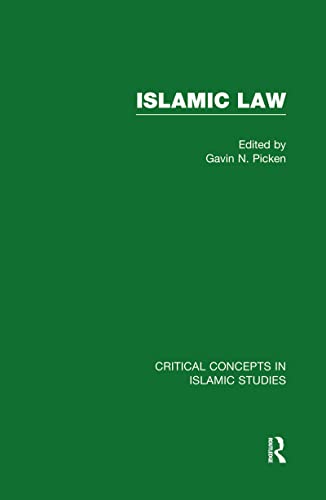
Islamic law edited by Gavin N. Picken : critical concepts in Islamic studies
Publication details: London: Routledge, 2011.Description: 4 vols. setISBN:- 9780415470766
- 340.59 ISL
| Item type | Current library | Call number | Status | Date due | Barcode | |
|---|---|---|---|---|---|---|
| Reference | Central Library Allama Iqbal Open University Islamabad Law Section | 340.59 ISL (Browse shelf(Opens below)) | Not for loan | 115592 | ||
| Reference | Central Library Allama Iqbal Open University Islamabad Law Section | 340.59 ISL (Browse shelf(Opens below)) | Not for loan | 115593 | ||
| Reference | Central Library Allama Iqbal Open University Islamabad Law Section | 340.59 ISL (Browse shelf(Opens below)) | Not for loan | 115591 |
Browsing Central Library Allama Iqbal Open University Islamabad shelves, Shelving location: Law Section Close shelf browser (Hides shelf browser)

Islamic law is a legal tradition entrenched within a religious context; it is one of the most intriguing and fascinating areas of Islamic Studies. Many practitioners of Islam believe that their lives should be governed by a divinely revealed and sanctioned form of law that affects every aspect of their daily routines. Thus, whether it be a conventional religious act such as prayer, a customary practice such as marriage, or commercial activities such as trade, all these activities are determined by their legal validity within the Islamic law. Islamic law has developed over many centuries of juristic effort into a subtle, complex, and highly developed reality. Thus, Islamic law, like any other, has its 'sources' ( al-masadir ); it also has its 'guiding principles' ( al-usul ) that dictate the nature of its 'evidence' ( al-adilla ); it equally employs the use of 'legal maxims' ( al-qawa'id ) and utilizes a number of underlying 'objectives' ( al-maqasid ) to underpin the structure of its legal theory. Volume I of this new Routledge collection brings together the best scholarship to detail the origins and sources of Islamic law. The materials in Volume II, meanwhile, examine the genesis of schools of law, their utilization of specific juristic methodologies, and their development of legal theory. Volume III focuses on the consolidation and stagnation of Islamic law in the medieval period, since although the development of the schools and a number of competing legal theories played a huge role in the codification of Islamic law, at the same time the competitive nature of such methodologies led to divisiveness because of strict adherence to a specific school. The final volume in the collection examines Islamic law today, and the challenges of living in a modern, technologically advanced world. Supplemented with a full index, Islamic Law includes a comprehensive introduction newly written by the editor which places the collected material in its historical and intellectual context. It is certain to be valued as a vital research resource
Eng
There are no comments on this title.